.png)
.png)


.png)


Wired vs. Wireless Smart Home Systems: Key Differences and How to Choose

When planning large residential properties, luxury hotels, or modern commercial spaces, selecting the right underlying communication protocol is a critical early-stage decision. The foundational architecture dictates not only the initial installation process but also the system's long-term stability and scalability.
For architects, project managers, and system integrators, the debate often centers around two main paths: wired and wireless networks. Understanding the advantages and limitations of each is essential for designing a robust intelligent environment. In this guide, we will explore the core differences between wired and wireless smart home systems and introduce an innovative hybrid approach that bridges the gap.
The Wired Approach: KNX and DALI
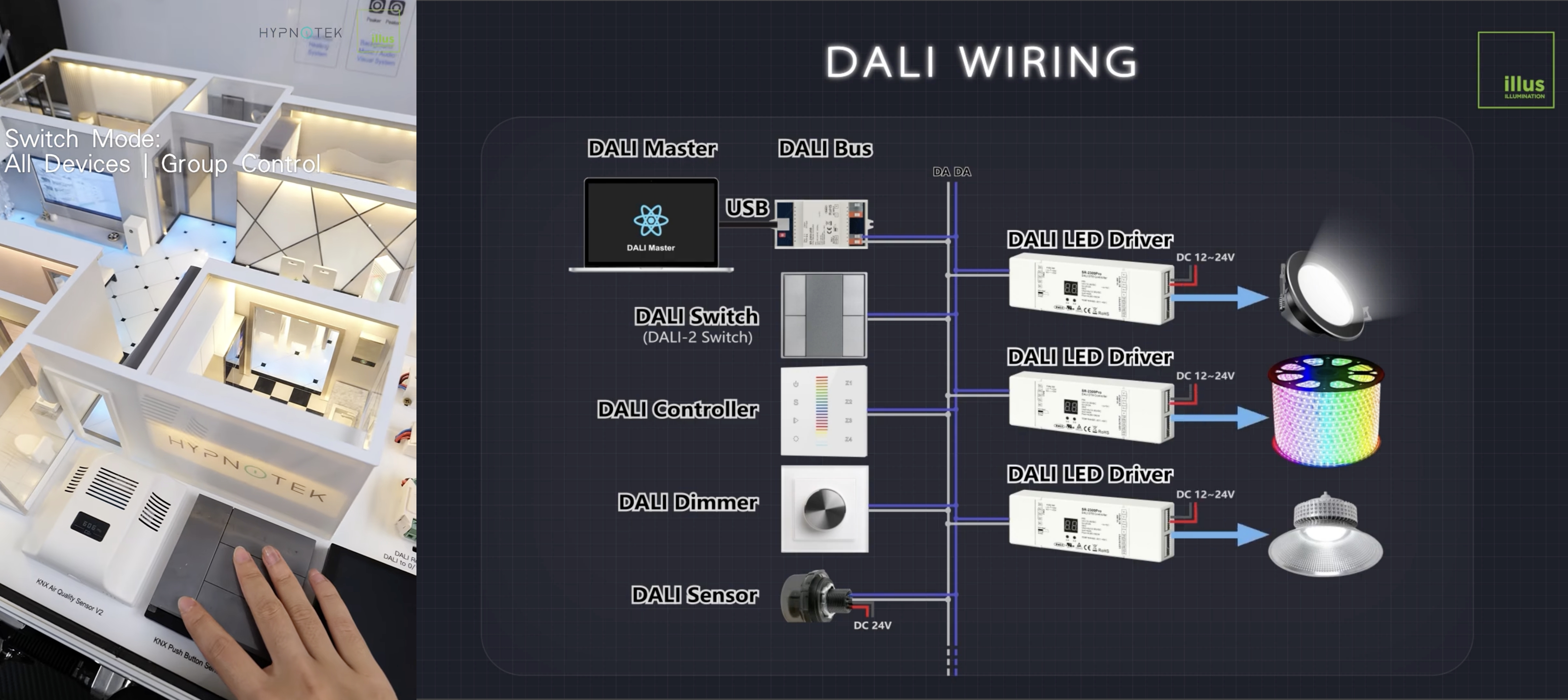
Wired smart home systems rely on physical communication cables (such as bus cables) to transmit data between control panels, sensors, and lighting fixtures. The most prominent protocols in the commercial and high-end residential sectors are KNX and DALI.
The Advantages:
The primary benefit of a wired system is its unparalleled reliability. Because data travels through physical cables, the system experiences virtually zero latency and is immune to wireless signal interference. KNX serves as an exceptionally stable backbone for comprehensive building automation, managing everything from HVAC to security. Meanwhile, DALI smart lighting protocols provide precise, flicker-free dimming and color temperature control for professional illumination. For a smart lighting manufacturer designing infrastructure for large commercial buildings, a wired approach is often the baseline for stability.
The Limitations:
The main challenge with wired networks is the initial deployment. It requires extensive planning, specialized wiring during the construction phase, and higher initial labor costs. Furthermore, modifying the system later—such as adding a new control panel on a solid wall—can be highly disruptive and costly, making it less ideal for retrofit projects.
The Wireless Approach: Zigbee 3.0
Wireless systems use radio frequency to communicate. In modern smart environments, Tuya Zigbee 3.0 has emerged as a leading protocol due to its low power consumption and mesh networking capabilities.
The Advantages:
The standout feature of a wireless smart home system is its installation flexibility. Wireless devices, such as kinetic switches or smart sensors, can be placed almost anywhere without tearing open walls or running new conduits. This zero-wiring capability makes wireless systems highly cost-effective and the preferred choice for retrofitting historical buildings, upgrading finished homes, or deploying dynamic office layouts.
The Limitations:
While highly adaptable, pure wireless systems can face challenges in ultra-large commercial spaces or buildings with exceptionally thick concrete walls. In such environments, the signal range may be restricted, often requiring the strategic placement of additional repeaters or gateways to maintain a strong, responsive mesh network.
The Best of Both Worlds: M+O Hybrid Architecture
Historically, project developers had to choose one path and accept its compromises. However, advanced IoT architectures are moving toward integration. Developed under the illus lighting brand, the Hypnotek ecosystem introduces the M+O Hybrid Wired & Wireless Integration technology.
This hybrid architecture is designed to bridge highly reliable wired ecosystems (KNX/DALI) with flexible wireless ecosystems (Tuya Zigbee 3.0).
How it Works:
- The core of this integration is the Protocol Converter (Zigbee ↔ KNX gateway).
- Zigbee end devices (like smart panels or mobile apps) initiate commands.
- The Zigbee Gateway transmits these commands to the protocol converter.
The converter translates the Zigbee signals into the KNX protocol, integrating smoothly with the KNX bus.
This allows data to be seamlessly exchanged between the wireless and wired subsystems. A central KNX controller can coordinate the overall building logic, while users enjoy the flexibility of adding wireless Zigbee devices whenever needed.
Comparison Overview
|
Feature |
Wired Systems (KNX/DALI) |
Wireless Systems (Zigbee 3.0) |
M+O Hybrid Architecture |
|
Stability & Latency |
Exceptionally high, zero latency |
High, but can be affected by interference |
High (wired backbone) with flexible nodes |
|
Installation Cost |
Higher (requires extensive wiring) |
Lower (easy to install) |
Moderate to High (optimized investment) |
|
Scalability |
Lower (hard to add new physical nodes) |
Very High (easy to add devices) |
Very High (best of both) |
|
Best Application |
New commercial builds, luxury infrastructure |
Retrofits, finished apartments |
Large villas, hotels, and complex projects |
How to Choose for Your Space
When consulting with a professional smart home solutions provider, the choice depends heavily on your project's current phase and structural limitations:
- For New Construction & Major Renovations: It is highly recommended to lay down a wired backbone (KNX/DALI) for essential infrastructure like main lighting and HVAC. You can then utilize the M+O hybrid architecture to add wireless Zigbee nodes for localized control, ensuring long-term stability while maintaining future expandability.
- For Finished Buildings & Retrofits: If the space is already decorated or features surfaces where drilling is prohibited (like glass partitions), a pure wireless Zigbee 3.0 system is typically the most practical choice. It minimizes architectural disruption while still delivering a comprehensive intelligent experience.
Conclusion
Choosing between wired and wireless smart home systems no longer means compromising on either stability or flexibility. By adopting a system with excellent compatibility and customizable underlying architectures—such as the M+O Hybrid technology—you can ensure the long-term usability and relevance of your building. Whether you are seeking robust commercial IoT lighting solutions or versatile residential automation, selecting an integrated ecosystem that aligns with the "One app solves everything" philosophy will define the ultimate success of your modern space.
Frequently Asked Questions
Q1: Can KNX and Zigbee devices work together in the same building?
A: Yes. Through advanced hybrid architectures like the Hypnotek M+O system, a Protocol Converter can translate Zigbee signals into KNX protocol. This allows seamless data exchange and unified control across both wired and wireless devices.
Q2: Are wireless smart home systems reliable for large properties?
A: Modern protocols like Zigbee 3.0 use mesh networking, where each powered device acts as a repeater to strengthen the signal. While highly reliable, very large properties or spaces with thick concrete walls may require a hybrid approach or additional gateways for optimal performance.
Q3: Which system is better for upgrading an older building?
A: A wireless system (such as Zigbee) is generally the best choice for older buildings. It eliminates the need for expensive and disruptive electrical rewiring, allowing for the easy installation of smart relays, wireless panels, and battery-free kinetic switches.